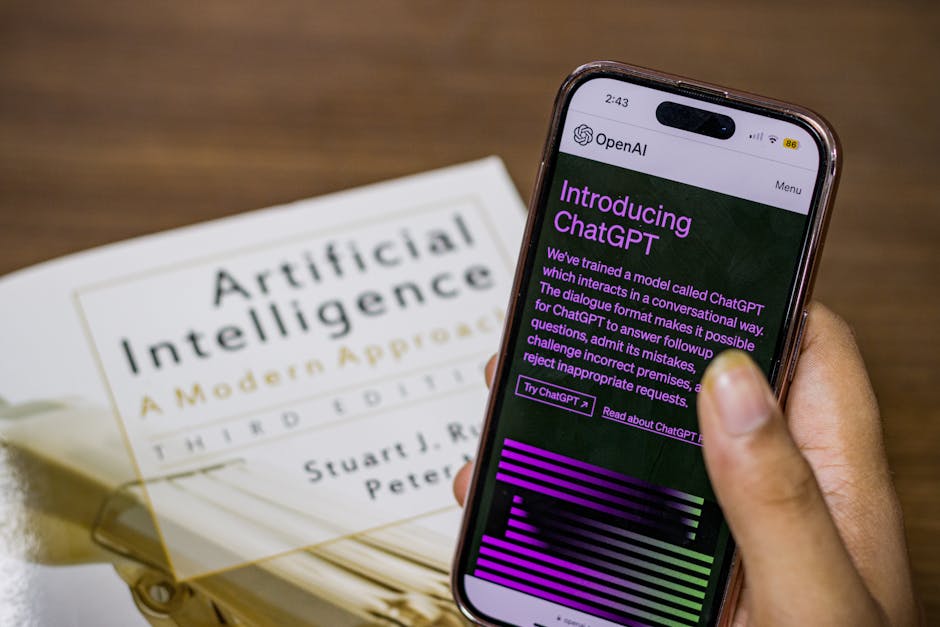
This guide covers everything you need to know about how to learn ai as a beginner, including practical examples, step-by-step instructions, and actionable tips you can implement today.
Unlock AI: 5 Steps for Absolute Beginners
Feeling like the world is moving at warp speed with all this talk about AI, and you're stuck at the starting line? You're not alone! Artificial intelligence isn't just for tech gurus anymore; it's a powerful tool ready to revolutionize how you work, create, and learn. This comprehensive guide is your friendly roadmap to demystifying AI and taking your very first practical steps. We're going to break down the intimidating buzzwords, introduce you to some fantastic free, beginner-friendly tools, and show you exactly how to start leveraging AI for productivity and creativity today. Let's dive in! 🚀Step 1: Understand the Basics: What is AI (Really)?
Before you can unlock AI's potential, let's clear up some common misconceptions. Forget the sci-fi movies where robots take over the world (at least for now!). In its current, practical form, AI is essentially a branch of computer science focused on building machines that can perform tasks that typically require human intelligence.Think of it as software that can:
- Learn: Identify patterns in data to make predictions or decisions.
- Understand: Process and interpret human language (text and speech) and images.
- Create: Generate new text, images, or even code based on instructions.
- Automate: Perform repetitive tasks efficiently.
Dispelling Myths & Focusing on Practicality
Many people think AI is overly complex or requires deep coding knowledge. This couldn't be further from the truth for everyday users. For absolute beginners, AI is about using readily available applications and websites that have AI capabilities built-in. You don't need to understand the intricate algorithms to benefit from them, just like you don't need to know how an engine works to drive a car!
The AI tools we'll focus on are designed to be intuitive. They take your plain language commands (called "prompts") and generate useful outputs. It’s all about communicating with the AI effectively, which we’ll cover in Step 3. 💡
Step 2: Choose Your First AI Playground (Free & Friendly!)
The best way to learn about AI is by playing with it! Fortunately, there are incredible free AI tools available that are perfect for beginners. These platforms allow you to experiment without any financial commitment or complex setup.Your Conversational AI Buddy: ChatGPT & Google Gemini
These are "Large Language Models" (LLMs), essentially super-smart chatbots that can understand and generate human-like text. They are fantastic starting points for almost anyone.
ChatGPT (OpenAI)
- What it is: A powerful AI chatbot capable of answering questions, writing text, summarizing documents, brainstorming ideas, and much more.
- How to start: Simply visit chat.openai.com, sign up for a free account (Google or email login), and start typing!
- Key Features for Beginners:
- Natural Language Interface: Just type what you want, like you're talking to a person.
- Versatility: Ask it anything – from explaining complex concepts in simple terms to writing a poem or drafting an email.
- Memory: It remembers the context of your conversation, allowing for follow-up questions and refinements.
- Practical Tip: Start by asking it to "explain quantum physics to me like I'm 5," or "write a short, friendly email inviting friends to a BBQ next Saturday."
Google Gemini (formerly Bard)
- What it is: Google's answer to ChatGPT, integrated with Google's search capabilities, meaning it often has access to more up-to-date information.
- How to start: Go to gemini.google.com and log in with your Google account.
- Key Features for Beginners:
- Real-time Information: Can pull live data from the web.
- Drafts: Often provides multiple draft responses to choose from.
- Image Input: Can analyze images you upload (e.g., "describe this picture").
- Practical Tip: Use Gemini to research a recent event, compare product reviews, or ask it to "summarize the latest news on [topic X]."
Action Step: Pick either ChatGPT or Gemini, create your free account, and spend 15 minutes asking it different questions. Don't be afraid to experiment! 🎯
Unleash Your Inner Artist: AI Image Generators
Want to create stunning visuals without any drawing skills? AI image generators are your ticket!
Copilot Designer (formerly Bing Image Creator)
- What it is: A powerful AI image generation tool powered by DALL-E 3 (OpenAI's image model), freely available through Microsoft's Copilot.
- How to start: Visit copilot.microsoft.com/images and log in with a Microsoft account.
- Key Features for Beginners:
- Excellent Quality: Generates high-quality images from text prompts.
- User-Friendly: Simple text input box.
- Free Credits: You get a certain number of "boosts" per day for faster generation, but you can still generate images without them, just slower.
- Practical Tip: Try simple prompts like "a golden retriever wearing sunglasses on a beach, realistic," or "fantasy castle in the clouds, watercolor style."
Playground AI
- What it is: A web-based AI image editor that offers various models (including Stable Diffusion) and more control for free users.
- How to start: Go to playgroundai.com and sign up for a free account.
- Key Features for Beginners:
- Generous Free Tier: Allows for a large number of images per day.
- Editing Tools: Basic editing capabilities directly within the platform.
- Style Presets: Easy to select different artistic styles.
- Practical Tip: Experiment with the different "filters" or "styles" to see how they change the output from the same prompt.
Action Step: Head to Copilot Designer or Playground AI and create 3-5 images using different prompts. See what crazy things you can come up with! 🎨
Step 3: Master the Art of Prompt Engineering (It's Easier Than You Think!)
This sounds fancy, but "prompt engineering" is just the skill of writing effective instructions (prompts) for AI tools. It's like learning to give clear directions. The better your prompt, the better the AI's response.Think of the AI as an incredibly intelligent, but literal, intern. It will only do exactly what you tell it. If you're vague, it will guess, and its guesses might not align with what you want.
The "CARE" Framework for Better Prompts
Here’s a simple framework to make your prompts more effective:
- C - Context: Give the AI background information. Why are you asking this? Who is the audience?
- Example: "I'm writing a blog post for absolute beginners about AI..."
- A - Action: Clearly state what you want the AI to do. Use strong verbs.
- Example: "...explain what prompt engineering is..."
- R - Role: Tell the AI what persona or role it should adopt. This helps shape the tone and style.
- Example: "...as if you're a helpful, friendly tutor..."
- E - Expectations/Examples: Specify the format, length, style, or provide examples of what you're looking for.
- Example: "...keep it under 100 words, use an analogy, and include an emoji."
Good Prompt vs. Bad Prompt Examples
- Bad Prompt (too vague): "Tell me about AI."
- AI Response: A generic, high-level overview.
- Good Prompt (using CARE): "Context: I'm preparing a presentation for high school students. Action: Explain the concept of machine learning. Role: Act as a cool science teacher. Expectations: Use a relatable analogy, keep it engaging, and provide 3 key takeaways in bullet points."
- AI Response: A much more tailored, useful explanation for the specific audience and purpose. ✅
For image generation, similar principles apply:
- Bad Prompt: "Dog on a couch." (You'll get a very generic image.)
- Good Prompt: "A fluffy golden retriever puppy curled up asleep on a plush velvet couch, cozy lighting, hyperrealistic, high detail, warm colors, bokeh background." (Much more specific and descriptive!)
Action Step: Go back to ChatGPT/Gemini or your image generator. Take a previous prompt and try to make it 5x more detailed using the CARE framework. Observe how the output dramatically improves. ⚡
Step 4: Real-World Use Cases: Boost Your Productivity & Creativity Today
Now that you know the tools and how to talk to them, let's explore how AI can actually make your life easier and more exciting. These are just a few ideas – the possibilities are truly endless!For Everyday Tasks & Productivity
- Email Drafting: "Write a polite email to my landlord requesting a leaky faucet repair, emphasizing I'm flexible for appointment times."
- Summarizing Information: Paste a long article or document and ask, "Summarize this in three key bullet points," or "Extract the main arguments for and against [topic]."
- Brainstorming Ideas: "Give me 10 ideas for healthy weeknight dinners that take under 30 minutes to prepare." Or, "Brainstorm unique birthday gift ideas for a friend who loves hiking and coffee."
- Learning & Explanations: "Explain the stock market to me in simple terms." Or, "What are the key differences between a Roth IRA and a Traditional IRA?"
- Language Practice: "Act as a Spanish tutor. Ask me 5 simple questions about my day and correct my grammar."
For Creative Endeavors
- Story & Blog Post Outlines: "Generate an outline for a blog post titled 'The Joys of Solo Travel' with 5 main sections and specific points for each."
- Content Generation: "Write a catchy social media post for a new coffee shop opening, including a call to action to visit."
- Art & Design Inspiration: Use an image generator to visualize concepts: "A futuristic city at sunset, neon lights, cyberpunk aesthetic," or "A whimsical forest scene with glowing mushrooms, detailed illustration."
- Code Generation (Simple): For very basic tasks, "Write a Python script to calculate the area of a circle." (Always double-check code generated by AI!)
Action Step: Think of one task you need to do this week (an email, a shopping list, a creative idea). Use an AI tool to help you complete it. You'll be surprised how much time you save! 💡
Step 5: Explore Beyond: What's Next on Your AI Journey?
You've taken your first steps, and hopefully, you're feeling excited! The world of AI is vast, and there's always more to discover.Experiment with More Advanced Tools
Once you're comfortable with ChatGPT, Gemini, and basic image generation, consider exploring these:
- Midjourney: Considered one of the leading AI image generators for artistic quality, but has a steeper learning curve and a subscription model (though there's a free trial on Discord).
- Claude (Anthropic): Another powerful LLM, often praised for its ability to handle longer texts and more nuanced conversations. Available for free, with paid tiers for more access.
- Perplexity AI: A fantastic "answer engine" that provides direct answers with sources, perfect for research and fact-checking. Free to use.
- Specialized AI Tools: There are AI tools for almost everything now: video editing, music creation, code generation, data analysis, and even customer service. A quick Google search for "AI tool for [your specific task]" can yield amazing results.
Learn from the Community & Stay Updated
- YouTube Channels: Many creators share tutorials, use cases, and news about AI. Search for "AI for beginners" or "ChatGPT tutorials."
- Online Forums & Communities: Reddit has active communities like r/ChatGPT, r/StableDiffusion, and r/singularity where users share tips, creations, and discuss the latest developments.
- Newsletters & Blogs: Subscribe to AI newsletters (like There's An AI For That or Future Tools) to stay informed about new tools and trends.
Embrace Ethical Considerations
As you use AI more, it's good to be aware of the broader implications. AI, while powerful, isn't perfect. It can sometimes generate biased information (based on biased training data), "hallucinate" (make up facts), or raise privacy concerns. Always critically evaluate AI-generated content, especially for important decisions or factual information. Use it as a powerful assistant, but always keep your own judgment front and center. Responsible use is key! ✅
Action Step: Set a reminder to spend 15 minutes each week exploring a new AI tool or learning resource. The more you explore, the more comfortable and adept you'll become! 🚀
Conclusion
Congratulations! You've just taken your first concrete steps into the exciting world of artificial intelligence. From understanding the basics to mastering prompts and discovering powerful, free tools, you're now equipped to start integrating AI into your daily life. Remember, AI isn't about replacing human intelligence; it's about augmenting it, freeing up your time for more creative and strategic thinking. Don't let perfection be the enemy of progress. Your next actionable step is simple: go open one of the tools mentioned above right now and try something! The more you experiment, the more you'll uncover AI's incredible potential to boost your productivity, spark your creativity, and unlock new possibilities. The future is here, and you're ready to be a part of it! ⚡ ---FAQ: Your AI Questions Answered
Q1: Is AI going to take my job?
A: While AI will undoubtedly change many job roles, it's more likely to augment human work rather than completely replace it, especially in the near future. The key is to learn how to work *with* AI, making yourself more efficient and valuable. Think of AI as a powerful co-pilot, not a replacement. People who know how to use AI effectively will have a significant advantage.
Q2: Are these AI tools really free? What's the catch?
A: Yes, many fantastic AI tools like the base versions of ChatGPT, Google Gemini, and Copilot Designer offer generous free tiers. There's no catch beyond perhaps needing to create an account. Companies often offer free versions to attract users, gather feedback, and then provide paid "pro" versions with more features, faster access, or higher usage limits for power users. For beginners, the free options are more than sufficient to get started.
Q3: Do I need coding skills to use AI?
A: Absolutely not for the tools we've discussed! These "no-code" AI applications are designed with user-friendly interfaces, allowing you to interact with them using plain English (or other natural languages). Your ability to communicate clearly through prompts is far more important than any coding knowledge.
Q4: Is my data safe when I use AI tools?
A: This is a very important question. When you input information into AI tools, it often becomes part of the data used to train and improve the AI models. Therefore, it's crucial to avoid inputting sensitive, personal, or confidential information (like credit card numbers, health records, or proprietary business data). Always review the privacy policies of any AI tool you use. For general, non-sensitive queries, the risk is typically low, but vigilance is always recommended.
Q5: What's the "best" AI tool for me to start with?
A: For absolute beginners, I highly recommend starting with ChatGPT or Google Gemini. They are incredibly versatile, easy to use, and excellent for understanding how conversational AI works. Once you're comfortable with one of these, then branch out to an image generator like Copilot Designer. The "best" tool ultimately depends on your specific needs, but these are solid starting points for everyone.
Have you tried any of these AI tools? What's been your experience? Share your thoughts in the comments below - I'd love to hear what's working for you!
Related Topics: #AI #ArtificialIntelligence #AITools #Productivity #Automation #Technology #Tutorial #Guide #TechTips
Comments
Post a Comment